


Introduction
A Changing World of Work The world of work is undergoing one of the most profound transformations in human history. Rapid technological advancements, shifting economic landscapes, and evolving societal expectations are redefining what it means to be employed. The once predictable path of education, employment, and retirement has given way to a more fluid and dynamic system driven by innovation and uncertainty. The future of employment is not only about jobs—it is about how people will adapt to continuous change, lifelong learning, and global connectivity.
Automation, artificial intelligence (AI), and robotics are already reshaping industries at an unprecedented pace. Routine and manual tasks are being replaced by intelligent machines, while new opportunities are emerging in data analytics, cyber security, digital design, and green technologies. At the same time, remote work and gig economies are dismantling traditional office structures, giving rise to flexible and independent work models. As we step into this new era, adaptability, creativity, and digital literacy will define the modern worker.
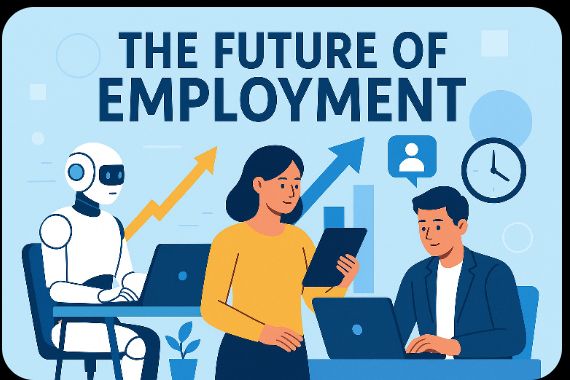
Technology and the Future Workforce Technology will remain the single most influential factor shaping employment in the coming decades. Artificial intelligence, for instance, is expected to automate up to 40% of current jobs within the next two decades. However, contrary to popular fear, automation is not entirely a job killer—it is a job transformer. While some positions disappear, new roles emerge that require human oversight, innovation, and emotional intelligence.
The rise of AI-driven industries is creating demand for new skill sets—data scientists, software developers, robotics engineers, and ethical AI specialists. Similarly, sectors such as healthcare and education are being revolutionized through telemedicine and online learning platforms. Workers of the future will need to continuously re skill and up skill to remain relevant. Lifelong learning will be essential, supported by online courses, vocational training, and company-led education programs.Moreover, the digital divide poses a critical challenge. While technology opens global opportunities, those without access to digital infrastructure or training risk being left behind. Governments and organizations must invest in equitable access to technology and education to ensure inclusive growth and social stability in the evolving labor market.
3: The Rise of Remote Work and the Gig Economy The COVID-19 pandemic accelerated a trend that was already underway: remote work. Today, millions of professionals can work from anywhere, thanks to cloud technology and virtual collaboration tools. This shift has redefined the employer-employee relationship, emphasizing results over physical presence. Companies now compete for global talent, while workers enjoy flexibility, autonomy, and better work-life balance.Alongside remote work, the gig economy—characterized by freelance, short-term, and contractual work—has flourished.

Platforms like Upwork, Fiverr, and Uber have enabled individuals to monetize their skills and time. However, this new employment model also comes with challenges: job insecurity, lack of benefits, and limited legal protections. The future of employment will therefore require policymakers to rethink labor laws to balance flexibility with social protection.Hybrid work models, combining both remote and in-office systems, are likely to dominate in the future. Organizations will design inclusive digital workplaces where collaboration, creativity, and innovation thrive. The shift also calls for a cultural transformation in management styles, with leaders focusing more on empathy, trust, and communication than on traditional supervisor
4: Green Jobs, Human Skills, and Conclusion Another defining trend in the future of employment is the rise of green jobs—positions that contribute to environmental sustainability. As the world grapples with climate change, industries such as renewable energy, waste management, and sustainable agriculture are expanding rapidly. Governments are investing heavily in green infrastructure, and corporations are embracing eco-friendly business models. This green transition will not only create millions of new jobs but also promote a healthier planet.Amid all these changes, human skills will remain irreplaceable. Creativity, emotional intelligence, critical thinking, and ethical judgment are uniquely human traits that machines cannot replicate. The most successful workers will blend technical expertise with soft skills, making them adaptable and innovative in uncertain times.

conclusion.
The future of employment will be defined by flexibility, technology, and sustainability. While automation and AI will continue to reshape industries, they will also open doors to new possibilities. The workers who embrace lifelong learning, digital literacy, and creativity will thrive in this evolving landscape. Governments, employers, and individuals must collaborate to build an inclusive future where everyone can benefit from technological progress. The future of work is not something to fear—it is an opportunity to reinvent how we live, learn, and contribute to society.
About The Author