



As organizations grow in size and complexity, the need for a centralized, transparent, and efficient Human Resource Management System (HRMS) becomes critical. KaziHR is designed to meet this need by providing a robust, multi-tenant platform that integrates human resources, finance, compliance, and departmental operations into a single, coherent system.
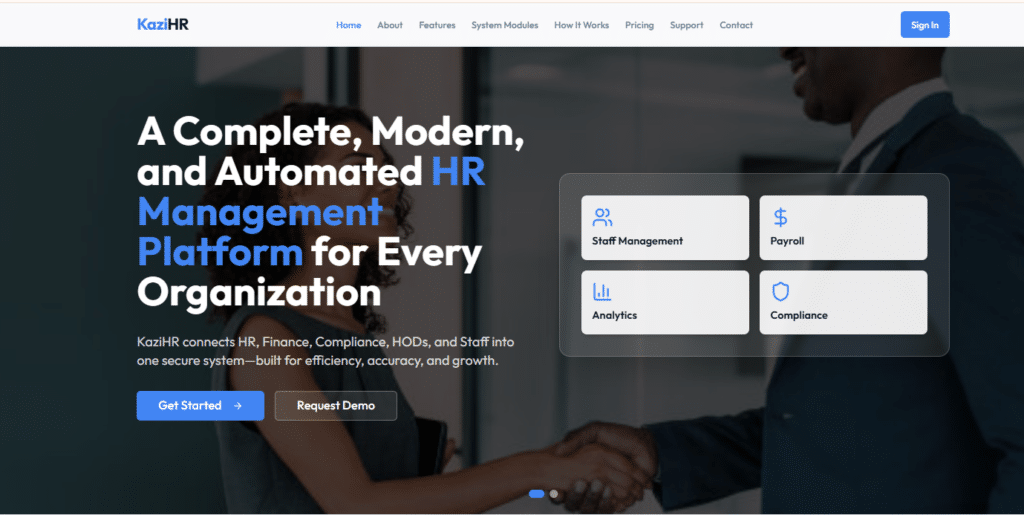
Built on strict role-based hierarchy and real-time data synchronization, KaziHR eliminates operational ambiguity, strengthens accountability, and ensures that every request, approval, and decision follows a clearly defined chain of command. The result is an organization that operates with greater clarity, efficiency, and governance.
The Core Philosophy of KaziHR
At the heart of KaziHR is a top-down hierarchical model that governs access, permissions, and workflows. This structure is not incidental—it is intentional. By enforcing a defined order of authority, KaziHR ensures that:
- Requests are routed to the correct decision-makers
- Approvals follow a consistent, auditable path
- Data integrity is maintained across departments
- Operational delays caused by confusion or misdirection are eliminated
The hierarchy flows as follows:
Developer → General Admin → HR Manager → Finance Manager → Compliance Officer → Head of Department (HOD) → Staff
Each role has clearly scoped responsibilities and system access, ensuring users see only what is relevant to their function.
A Unified System with Real-Time Intelligence
Despite its strict hierarchy, KaziHR delivers a unified user experience across all roles through several system-wide features:
- Real-Time Dashboards: Key metrics such as staff counts, pending approvals, payroll totals, and task statuses update instantly across all relevant accounts.
- Notifications and Messaging: Users receive immediate alerts for approvals, tasks, and messages through a notification bell and internal inbox.
- Profile Management: Every user can manage their personal profile, including uploading a profile photo.
- Role-Specific Chatbot Assistant: A built-in assistant provides contextual guidance based on the user’s role, with clear escalation paths for complex queries.
These shared capabilities ensure consistency while still respecting role-based boundaries.

Platform Governance: The Developer Role
The Developer functions as the platform owner and global administrator of KaziHR. This role is responsible for onboarding client organizations, managing system-wide configurations, and ensuring platform stability.
Key responsibilities include:
- Creating and managing independent organizational tenants
- Configuring global system settings such as branding and currencies
- Inviting General Admins for each organization
- Monitoring platform usage and billing metrics
The Developer establishes the foundation upon which each organization builds its internal structure.
Organizational Control: The General Admin
Within each organization, the General Admin holds the highest level of authority. This role is strategic in nature, focusing on structure, access, and oversight.
The General Admin:
- Defines departments and organizational structure
- Invites and manages all users across roles
- Uploads and distributes company policies
- Oversees HR, compliance, and payroll data (read-only for payroll)
- Approves senior-level leave requests and receives system-wide updates
When a new user is invited, KaziHR automatically integrates them into payroll, departmental views, and dashboard metrics, reducing manual setup and errors.
Human Capital Management: The HR Manager
The HR Manager sits at the operational core of KaziHR, managing the full employee lifecycle and acting as a critical approval authority.
Core responsibilities include:
- Managing recruitment and job postings
- Overseeing employee records and documents
- Uploading and distributing HR policies
- Approving leave, loans, and expenses at designated stages
- Monitoring departmental performance
- Initiating salary adjustments in coordination with Finance
The HR Manager ensures that people-related decisions align with organizational policies and workflows before progressing to financial execution.
Financial Stewardship: The Finance Manager
The Finance Manager is responsible for financial accuracy, payroll integrity, and budget control. This role translates HR and administrative decisions into financial outcomes.
Key functions include:
- Managing and submitting monthly payroll
- Approving loans and expenses after HR review
- Setting and tracking departmental budgets
- Monitoring financial dashboards and variance metrics
Payroll submission is a controlled process: once submitted, payslips become immediately available to staff, while Admin and HR gain read-only visibility. Resubmissions overwrite previous data, ensuring a single source of truth.
Governance and Oversight: The Compliance Officer
The Compliance Officer focuses on regulatory adherence and internal governance. This role ensures that documentation, audits, and compliance reporting meet required standards.
Responsibilities include:
- Managing compliance and audit documents
- Executing compliance reports
- Communicating compliance issues across management
- Submitting personal leave requests through HR
This role strengthens organizational accountability and risk management.
Departmental Leadership: The Head of Department (HOD)
HODs bridge management and execution. They are responsible for supervising staff, assigning tasks, and approving requests at the departmental level.
Their responsibilities include:
- Managing departmental staff (“My Team” view)
- Assigning tasks and training
- Approving leave and attendance records
- Submitting departmental expenses
- Monitoring team performance in real time
Task assignments and status updates are instantly reflected on dashboards, enabling continuous performance visibility.
The Staff Experience
Staff members interact with KaziHR primarily through self-service and task execution tools. Their access is focused, intuitive, and role-appropriate.
Staff can:
- View payslips and company policies
- Submit leave and loan requests
- Upload and manage personal documents
- Receive, update, and complete tasks
- Clock in and out for attendance
- Complete assigned training modules
Each request follows a transparent approval path, with real-time status updates visible to the employee.
Integrated Workflows in Action
KaziHR’s strength lies in how roles interact. For example, a departmental expense claim flows seamlessly from HOD submission, to HR review, to Finance approval, with automatic dashboard updates at each stage. This cross-functional automation reduces delays, improves transparency, and enforces accountability without manual follow-ups.
Conclusion
KaziHR is more than an HR system—it is an organizational operating framework. By combining strict role-based hierarchy, real-time data synchronization, and automated approval workflows, KaziHR enables organizations to operate with discipline, clarity, and efficiency.
When users understand and perform their roles within this structure, the entire organization benefits from improved governance, faster decision-making, and greater operational confidence. KaziHR ultimately empowers organizations to manage people, processes, and performance in a unified and scalable way.
About The Author