



Introduction.
For decades, humanity has looked to the skies with curiosity, ambition, and hope. From the first satellite in 1957 to the Moon landings, the creation of the International Space Station (ISS), and the current race to explore Mars, space exploration has remained one of the most powerful symbols of human innovation. Yet, as societies face urgent challenges such as poverty, climate change, unemployment, disease, and political instability, some argue that space exploration is a luxury we no longer need. However, the truth is the opposite: space exploration matters now more than ever. It drives scientific discovery, economic development, environmental monitoring, technological innovation, and global unity. Ultimately, exploring space helps us understand and protect life on Earth while preparing for humanity’s long-term survival.
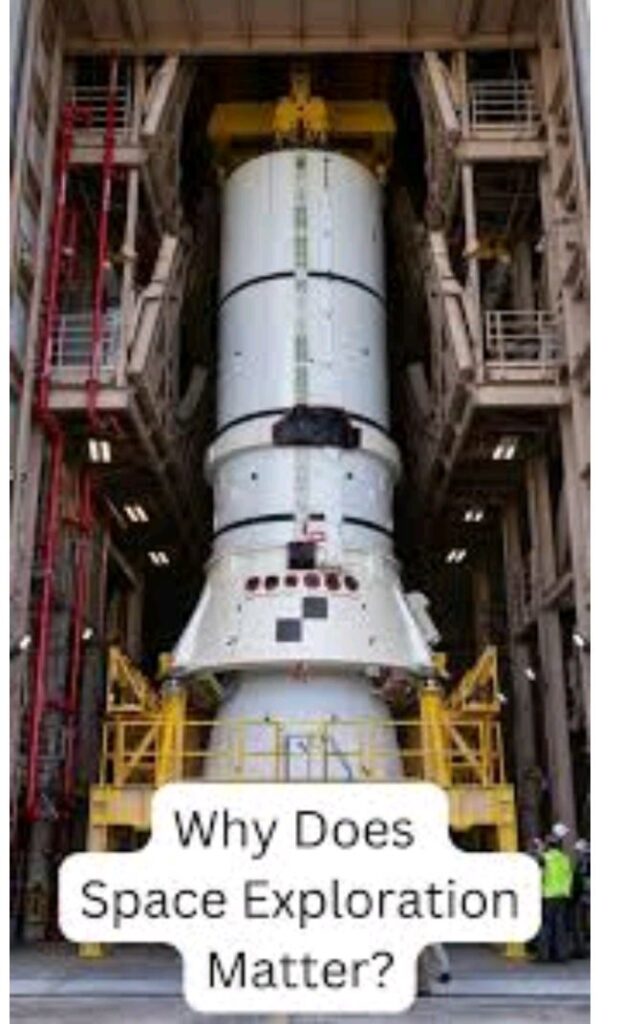
1. Space Exploration Enhances Scientific Knowledge One of the most significant reasons space exploration still matters is its contribution to scientific discovery. By studying planets, stars, asteroids, and galaxies, scientists gain valuable insights into the origins of the universe and the forces that shape it. Missions to Mars, for example, help researchers investigate whether life ever existed on other planets. Understanding other worlds helps us better understand Earth’s structure, climate, and history.
Space telescopes such as the Hubble Space Telescope, and now the James Webb Space Telescope (JWST), have revolutionized astronomy. They allow scientists to observe distant galaxies, detect exo planets that could host life, and study phenomena like black holes and dark matter. These discoveries expand human knowledge and push us to think beyond our immediate environment.Scientific research in space also advances biology, physics, and medicine. Experiments conducted on the ISS—where microgravity allows scientists to study processes impossible to observe on Earth—have improved understanding of human health, aging, and disease. Such research has contributed to progress in treating conditions like osteoporosis and muscle weakening.
2. Technological Innovation That Benefits Everyday Life Many people do not realize that space exploration has led to countless technologies we use daily. These innovations—known as “spin-offs”—were developed for space missions but ended up transforming industries on Earth.Examples include:GPS navigation, originally developed using satellites for space missions.Weather forecasting technologies, which rely on satellites that monitor atmospheric changes.Medical imaging tools, such as MRI and CT scan improvements, which were influenced by space research.Solar panels and battery technology enhanced through spacecraft energy systems.Water purification systems designed for astronauts but now used in many developing regions.Fire-resistant materials, memory foam mattresses, and scratch-resistant lenses.Space exploration acts as a catalyst for innovation. It challenges engineers to build smarter, lighter, more durable technologies, which then find use in industries such as health, transportation, and communication. In this way, space science directly improves the quality of life on Earth.
3. Space Exploration Strengthens Global Communication Modern communication depends heavily on satellites—devices placed into orbit through space programs. Without satellites, the world would lose:Reliable mobile networks Internet connectivity Television broadcasting Navigation systems Accurate climate and weather data These technologies keep businesses running, support education, link communities, and enable emergency services. Countries across Africa, including Kenya, rely on satellite communication for banking networks, remote learning, agricultural monitoring, and disaster response.Space exploration ensures these systems continue to grow and improve. As more satellites are launched, connectivity becomes faster and more accessible. This contributes to the global digital economy and helps bridge the digital divide between developed and developing countries.

4. Monitoring and Protecting the Earth Space exploration is essential for environmental protection. Satellites continuously scan Earth’s surface and atmosphere, providing critical data on:Climate change Deforestation Ocean pollution Ice sheet melting Natural disasters such as floods, droughts, and storms Agricultural patterns and food security .
This information helps scientists and governments predict weather events, manage natural resources, and plan responses to disasters. In Africa, satellite data supports early warning systems for drought and famine, allowing authorities to prepare interventions that save lives.Additionally, studying other planets like Venus and Mars—both of which experienced dramatic climate transformations—teaches us how delicate Earth’s climate is. Understanding these changes offers lessons on how to prevent environmental collapse here on Earth.
5. Economic Growth and Job Creation Space exploration is not just a scientific endeavor; it is also an economic engine. The global space industry is worth hundreds of billions of dollars and continues to grow. It includes:Satellite manufacturing Launch services Space tourism Space mining research Robotics and AI development Communication and broadband services Countries investing in space—like the United States, China, India, and the United Arab Emirates—have seen economic benefits through job creation, investment opportunities, and technological advancement.
Even nations without their own space agencies benefit by participating in satellite programs or partnering on international missions.Kenya, for example, has already launched its own cube satellites and is developing its space sector to support communication, agriculture, and climate monitoring. As the space economy grows, more opportunities arise for young people in STEM fields—engineering, programming, robotics, and environmental science.
6. Inspiring the Next Generation Space exploration has always served as a powerful source of inspiration. When young people see astronauts walking on the Moon, rovers driving on Mars, or rockets launching into space, they are encouraged to dream big. This inspiration motivates students to pursue careers in science, technology, engineering, and mathematics.These fields are essential for the future global workforce. Encouraging curiosity and scientific thinking prepares the next generation to solve complex world problems—whether in medicine, energy, agriculture, or climate science. Space exploration reminds humanity that innovation begins with imagination.
7. Ensuring Humanity’s Long-Term Survival Perhaps the most profound reason space exploration still matters is that it helps secure the future of humanity. Earth faces long-term risks such as:Asteroid impacts Supervolcanoes Climate change Resource depletion Overpopulation Global pandemics While some of these threats may be unlikely, they are possible. Exploring space gives humanity a chance to become a multi-planet species—able to survive if disaster strikes Earth. Research on Mars, the Moon, and asteroids could provide resources such as water, minerals, and metals that may one day support off-world colonies.Although colonizing other planets may still be far away, investing in space exploration today builds the foundation needed for future survival.
8. Promoting International Cooperation Space exploration brings nations together. Even during political tensions, countries have collaborated on missions such as the ISS, which has hosted astronauts from the US, Russia, Europe, Japan, and many others. These partnerships promote peace, communication, and shared scientific progress.Similarly, Africa is increasingly involved in collaborative space projects that help monitor the continent’s environment and improve communication. Cooperation in space demonstrates what humanity can achieve when nations work together for a common goal.

Conclusion.
Space exploration remains one of the most valuable and meaningful human pursuits. It drives scientific innovation, supports global communication, strengthens environmental protection, boosts economies, inspires generations, and encourages international unity. Most importantly, it helps humanity prepare for the future—both on Earth and beyond.Although challenges on our planet are urgent, investing in space exploration does not mean ignoring these problems. Instead, the discoveries and technologies developed for space often become the very tools that help us address global issues.Space exploration still matters because it pushes us to think beyond today, innovate for tomorrow, and imagine a future where humanity continues to grow. As long as the stars shine above us, they will continue to call us to explore, learn, and dream.
About The Author